


Pin-connected open-web trusses
Wood chords. Tubular steel webs. Patented knurled steel pin connections. WebJoist® open-web trusses deliver long spans, open mechanical chases and a clean exposed look — custom designed for every project.
What is a pin-connected open-web truss?
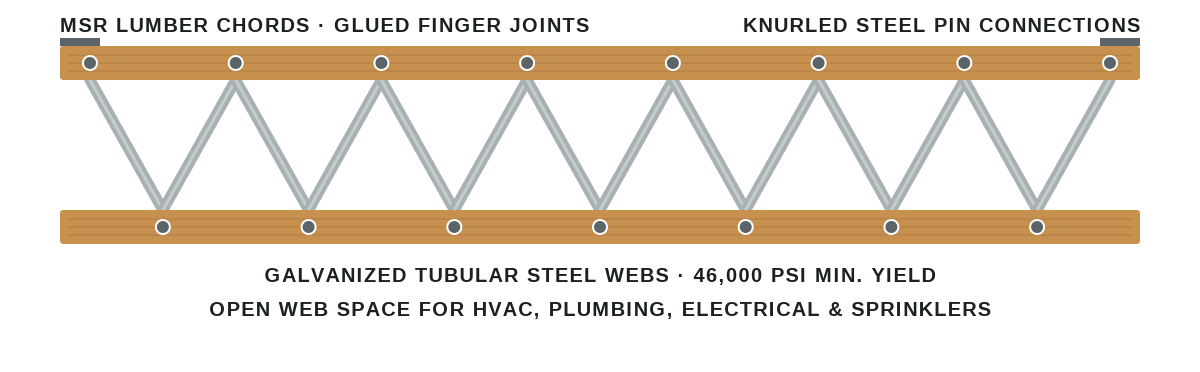
A pin-connected open-web truss is an engineered floor or roof member made of solid machine-stress-rated (MSR) lumber chords joined by diagonal galvanized tubular steel webs. The machined web ends insert into the chords and lock in place with knurled steel pins. The result combines the bending strength of wood with the tension and compression capacity of steel — and leaves the space between chords open for HVAC, plumbing, electrical and sprinkler lines.
WebJoist® builds every truss to order at its plant in Chehalis, Washington. Each one is custom designed with specialized software for the project's span, depth, spacing and loads, and shop drawings are approved before fabrication begins.
WebJoist® is one of only two manufacturers of pin-connected open-web wood trusses in North America — and the only independent, family-owned one.

Truss specifications
- Version 1 depth
- 14"–40"Parallel chord; 14"–44" tapered or pitched
- Version 2 depth
- 22"–48"Parallel chord; 18"–52" tapered or pitched
- Chords
- MSR lumber2×4 or 2×6 MSR (V1); 3×4 LAM-CHORD (V2); glued finger joints
- Webs
- 46,000 psiMin. yield galvanized steel tubing; 1", 1-1/8", 1-1/4", 1-1/2" diameters; 13–19 gauge. Double steel-angle webs also available
- Connections
- Steel pinsKnurled pins, 3/8" to 3/4" diameter, patented knurled upset
- Weight
- ≈ 4 plfVersion 1 — light enough to set without a crane in many cases
Series designations
| Version | Chord material | Series | Parallel depth | Taper / pitch depth |
|---|---|---|---|---|
| Version 1 | 2×4 MSR lumber | WJSS · WJ21 · WJ24 · WJ27 · WJ28 | 14"–40" | 14"–44" |
| Version 1 Wide | 2×6 MSR lumber | WJ21W · WJ24W · WJ28W | 14"–40" | 14"–44" |
| Version 2 | 3×4 LAM-CHORD | WJ-L6 | 22"–48" | 18"–52" |
Series number reflects chord grade (2100f, 2400f, 2850f MSR). ICC-ES ESR-2504 recognizes additional Version 1 designations. Final design values per the WebJoist® Truss Product Guide and ESR-2504.
Profiles for floors, roofs and architectural ceilings
Parallel chord
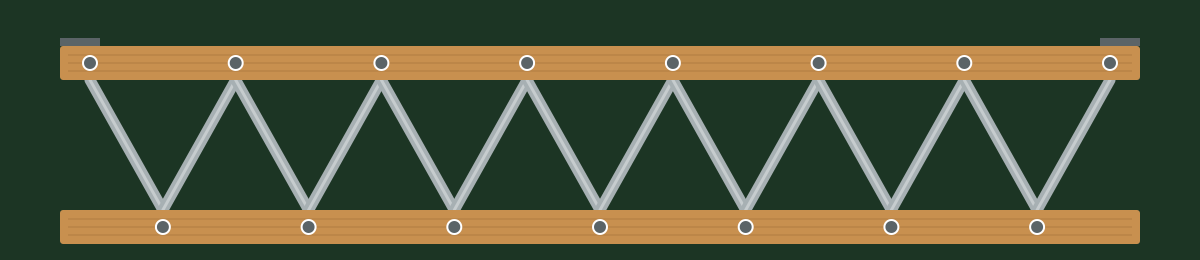
The standard floor and flat-roof profile, with top or bottom chord bearing and optional cantilevers.

Tapered
Single- or double-taper top chords build roof slope and drainage into the structure.

Pitched & radius
Pitched and radius-ridge profiles for sloped roofs and feature ceilings. Other profiles on request.
Bearing options
Top chord or bottom chord bearing, with or without cantilevers. Steel bearing angles are used at truss supports, and web ends bear directly on supports.
Accessories
Bridging, bridging straps and precut blocking are designed and supplied with the package — one order, one delivery.
Why specify pin-connected open-web trusses
Long spans, wide spacing
A high strength-to-weight ratio outperforms plated wood trusses on longer spans and wider on-center spacing.
Open MEP chases
Ducts, piping, conduit and sprinklers run through the webs — no notching, drilling or bulkheads.
Light and fast to set
Version 1 trusses weigh about 4 pounds per lineal foot, simplifying handling and installation.
Exposed-structure aesthetic
Warm wood chords with crisp galvanized webs — widely preferred for exposed truss ceilings.
Code recognized
Evaluated under ICC-ES ESR-2504 for the IBC and IRC, with a California supplement.
Works with your system
Pairs with WEB-i® joists, WebLam™ beams as well as plated trusses, GLB, and mass timber in a hybrid package.
Open-web floor and roof trusses
Floor trusses carry commercial occupancies in offices, schools, mixed-use and multi-family buildings, with the mechanical system tucked inside the floor depth to reduce floor-to-floor height.
Roof trusses span restaurants, retail, fire stations, gymnasiums and warehouses, with tapered and pitched profiles for drainage and roof-top equipment loads designed in.
Common projects include fast-food franchise restaurants, municipal facilities like fire stations, public and private schools and everyday retail buildings.
See applicationsOpen-web truss questions
What is a pin-connected open-web truss?
A pin-connected open-web truss is a composite structural member with solid wood top and bottom chords connected by diagonal tubular steel webs. The machined ends of the steel webs are inserted into the chords and secured with steel pins, creating a light, stiff truss with open space between the chords for ductwork, piping and wiring.
How deep can WebJoist® open-web trusses be?
Version 1 trusses (2×4 or 2×6 MSR chords) are made 14" to 40" deep with parallel chords and 14" to 44" deep in tapered or pitched profiles. Version 2 LAM-CHORD trusses are 22" to 48" deep parallel and 18" to 52" deep tapered or pitched.
Are WebJoist® trusses code approved?
Yes. WebJoist® pin-connected open-web trusses are recognized in ICC-ES evaluation report ESR-2504, which covers the 2024, 2021, 2018, 2015 and 2012 IBC and IRC and includes a California supplement.
How do pin-connected trusses compare with plated wood trusses?
Pin-connected trusses have a higher strength-to-weight ratio than metal-plate-connected wood trusses, allowing longer spans and wider on-center spacing for commercial floors and roofs. Many projects use both — pin-connected trusses where spans and loads demand them, plated trusses elsewhere and are especially suited for integrated parapet solutions.
Can open-web trusses be left exposed?
Yes. Architects and engineers frequently specify exposed open-web trusses for the look of warm wood chords and crisp galvanized steel webs in restaurants, schools, retail and offices. They create both a modern and industrial open feel prized for its' simple clean construction. Just look up, you'll likely see us when your out.
Do the trusses meet a 0.50 specific gravity requirement?
Yes. WebJoist® pin-connected trusses meet 0.50 specific gravity requirements through the species and/or grade of chord stock when specified.
Is WebJoist® an approved equal to RedBuilt open-web trusses?
In many applications, yes. Both manufacturers' reports were evaluated under the same acceptance criteria (AC306) and publish closely matching design values: WebJoist® Version 1 2×4 trusses and RedBuilt Red-L use the same chord size and pin diameters. Acceptance is decided by the engineer of record. See the WebJoist® vs. RedBuilt series crosswalk.
Ready to price WebJoist® open-web trusses?
Send your plans and specifications. Our design team reviews every project and returns a customized package quote — trusses, joists, accessories and freight — through your local LMC dealer.