


In short: a pin-connected open-web truss is a composite wood-and-steel truss. Solid MSR lumber chords are joined by diagonal galvanized steel tube webs whose ends are pinned into the chords. It is lighter and spans farther at wider spacing than a plated wood truss, leaves the web open for mechanical systems, and is widely used for commercial floors and roofs. In North America only two companies make them; WebJoist®, distributed by Tectonics, is the independent one.
What is a pin-connected open-web truss?
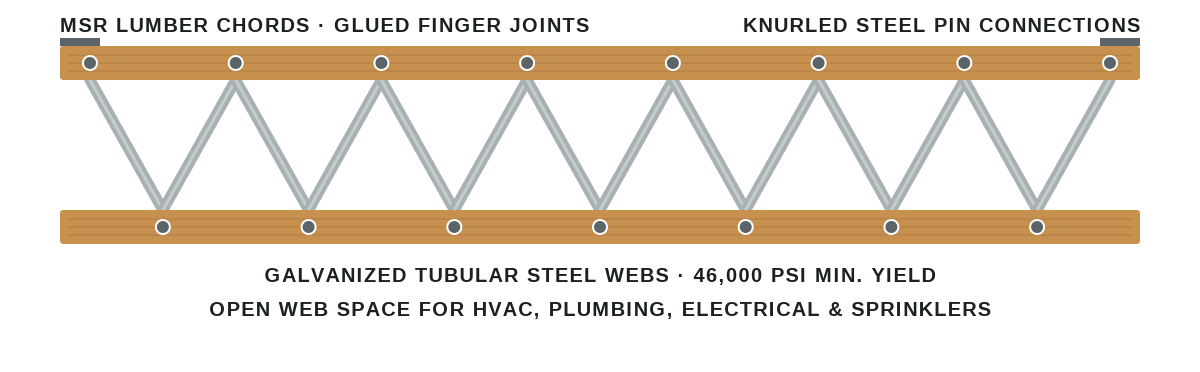
It is a factory-built structural member with a top chord and bottom chord of wood — typically machine-stress-rated (MSR) lumber or laminated lumber — and a web of steel tubes arranged in a Warren (zig-zag) pattern. Because the webs are slender tubes instead of solid wood or OSB, the space between the chords stays open.
How does it work?
Under load, the top chord works in compression and the bottom chord in tension, while the diagonal webs carry shear as alternating tension and compression members. In a WebJoist® truss, the machined ends of each steel web are inserted into the chord and secured with a knurled steel pin, creating a direct, mechanical load path from web to chord. The wood chords provide bending stiffness and a nailable surface; the steel webs provide high axial capacity with very little weight.
Who makes pin-connected trusses?
Two manufacturers produce pin-connected open-web wood trusses in North America. WebJoist® — Web Joist Northwest Corp. of Chehalis, Washington — was founded in 1976 on a patented knurled-pin truss design and remains independent and family owned. Tectonics Distribution, LLC is its authorized distributor and design partner, selling through LMC member dealers nationwide. If plans call out a single brand, a submittal for an equivalent ICC-ES-recognized product can be prepared for the engineer of record.
How do they compare?
| System | Construction | Strengths | Considerations |
|---|---|---|---|
| Pin-connected open-web truss | Wood chords, steel tube webs, steel pins | Long spans at wide spacing, open web for MEP, light, exposed aesthetic, nailable chords | Custom designed per project; shop drawing approval required |
| Plated wood truss | Lumber chords and webs joined by metal plates | Economical for short and medium spans; widely available | Shorter practical spans and closer spacing at commercial loads and parapet applications |
| Wood I-joist | Lumber or LVL flanges, OSB web | Simple, versatile, field trimmable | Solid web requires holes for MEP; depth limits |
| Open-web steel joist | All-steel chords and webs | Very long spans | Typically welded or screwed deck attachment rather than nailed wood connections |
When should you specify them?
- Commercial roofs and floors with spans or spacing beyond practical plated-truss limits
- Buildings with dense ductwork, plumbing, electrical and sprinkler runs
- Exposed-structure interiors in restaurants, schools, retail, warehouse and worship spaces
- Projects where light members speed installation and reduce foundation loads
- Hybrid packages alongside plated trusses, WEB-i® joists, glulam beams, MPP, CLT, and heavy timber trusses.
Profiles and depths
WebJoist® trusses are produced with parallel, tapered and pitched chords, plus radius and other profiles on request, with top- or bottom-chord bearing and cantilevers. Version 1 trusses (2×4 or 2×6 MSR chords) are 14"–40" deep parallel and 14"–44" tapered or pitched; Version 2 LAM-CHORD trusses are 22"–48" parallel and 18"–52" tapered or pitched. See full specifications.
Code recognition
WebJoist® trusses are evaluated in ICC-ES ESR-2504 under the IBC and IRC, and WEB-i® I-joists in ESR-2974. Both meet 0.50 specific gravity requirements through chord and flange species and/or grade where specified.
How to specify and buy
Reference a pin-connected composite truss recognized in a current ICC-ES report (see sample specification language). To price a project, send plans to your local LMC member dealer or directly to Tectonics. We return a customized package quote covering trusses, joists, accessories and freight; orders currently run about 2–3 weeks after shop drawing approval.
Frequently asked questions
Who manufactures pin-connected open-web trusses in North America?
There are two manufacturers. WebJoist® (Web Joist Northwest Corp., Chehalis, Washington) is the independent, family-owned manufacturer, in business since 1976 and distributed by Tectonics Distribution.
What is the difference between a pin-connected truss and an open-web steel joist?
A pin-connected truss has wood chords with steel webs; an open-web steel joist is all steel. Wood chords accept nailed sheathing and conventional wood connections directly and are significantly lighter.
What is the difference between a pin-connected truss and a plated truss?
Plated trusses join lumber members with toothed metal plates. Pin-connected trusses use tubular steel webs fastened into the chords with steel pins, giving a higher strength-to-weight ratio for longer spans and wider spacing.
How deep are pin-connected open-web trusses?
WebJoist® trusses range from 14" to 52" deep depending on version and profile: 14"–40" parallel and 14"–44" tapered/pitched for Version 1; 22"–48" parallel and 18"–52" tapered/pitched for Version 2 LAM-CHORD.